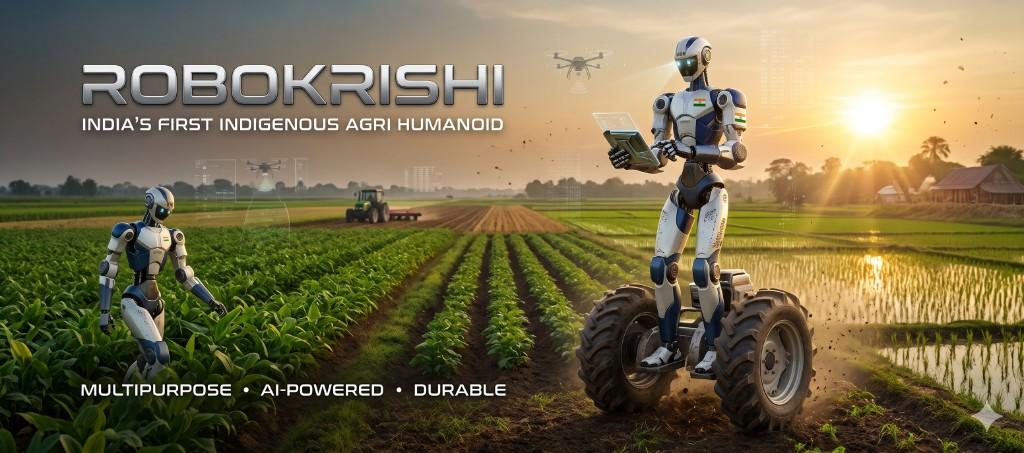
RoboKrishi — India's first indigenous agri humanoid

ETA 2030

HUMANOID · FIELDAI · INDIGENOUS

Multipurpose · AI-powered · Durable

Scroll for the 2030 road map

RoboKrishi

India's first indigenous agri humanoid

A multipurpose field humanoid built for Indian plots — pairing legged mobility, precision manipulation, and on-board agronomy AI. Below is the capability road map our R&D is targeting, aligned with global research on field autonomy, human-scale manipulation, and fleet coordination.

  • 2030

    Commercialisation window

  • Human-scale

    Field manipulation

  • Multi-modal

    Vision · lidar · soil

  • Fleet

    Drone & robot sync

2030 capability road map

What global research is converging on — and what we ship toward

Across universities, national labs, and ag-tech companies, work through the 2020s converges on: robust outdoor autonomy in mud and crop (vision + lidar fusion, learning-based control), selective crop care (per-plant sensing and actuation), safe operation near people and livestock (ISO-style ag-robot standards maturing by decade's end), digital twins and weather-aware planning, and orchestration with aerial drones and irrigation systems. By 2030, credible road maps point to limited commercial deployment of human-scale helpers for inspection, logistics, and assisted harvest — not full replacement of seasonal labour, but measurable lift in labour productivity and input precision.

Autonomy stack

All-terrain perception & control

Research programmes worldwide are hardening SLAM, terrain adaptation, and learning-based locomotion for unpaved bunds, wet rows, and slope — the same problems RoboKrishi must solve for Indian field geometry.

  • RGB + depth + lidar fusion for mud, crop clutter, and low sun
  • Learned foothold and slip recovery on uneven surfaces
  • Geofenced missions with RTK/GNSS when canopy allows fixes
  • Rain-aware slowdown and contingency handoff to tele-op

Precision agronomy

Per-plant care & early stress

Field robotics labs are moving from plot-level to plant-level interventions — selective scouting, targeted inputs, and repeatable phenotyping that extension teams can trust.

  • Canopy-close multispectral for nitrogen, moisture stress, and disease onset
  • Hyperspectral-ready payloads for research-grade fingerprinting (module path)
  • Digital twin tie-in — what the field looked like last week vs today
  • Exportable observation logs for agronomists and FPO dashboards

Manipulation

Logistics, sampling & assisted tasks

By 2030, humanoids are expected to handle repeatable payloads — carrying tanklets, soil cores, nursery trays, and harvest aids — with supervised autonomy in unstructured rows.

  • Tool interchange for probe, sprayer wand extension, light carry
  • Gentle pick/place tuned for bruise-prone produce (variety-specific SOPs)
  • Docking with a compact field trailer or ATV for battery and water
  • Collaborative stops when children, animals, or vehicles enter the safety zone

Orchestration

Drone · irrigation · weather fabric

Robotics road maps assume robots do not work alone — they subscribe to the same mission fabric as UAVs (e.g. VayuKrishi-class scouts), drip schedules, and short-horizon weather.

  • Shared task queue: drone maps, ground robot executes ground-truth strips
  • Rain and wind gates from IMD-style feeds to pause blade-near-canopy work
  • Water-stress cues from soil probes routed into the shift plan
  • API-friendly hooks for state scheme reporting where required

Safety & trust

Work-safe beside farmers

ANSI/ISO work on ag robots, EU machine-operability pilots, and insurer expectations are converging on explicit speed zones, pinch protection, and auditable logs — prerequisites for village-scale trust.

  • Rated stop time and protective stop on lidar + rad breaking beams
  • Day/night lighting and reflective kit for bund-edge visibility
  • Tamper-evident mission logs for liability and training proof
  • Operator-in-the-loop for first-season deployments in dense villages

Economics

Built for Indian unit economics

Research on service robots in emerging markets stresses amortisable platforms, local spare depth, and training ladders — not one-off demos.

  • Modular actuators for field-replaceable repairs
  • CHC / FPO pooling models aligned to custom-hiring centre rhythms
  • Power options: swap battery packs or short tether for demo plots
  • Skill ladders: Rover → supervised humanoid → light autonomy expansion

RoboKrishi — express interest

Road-map briefings, pilot geographies, and co-development for 2030-class humanoids — reach our team.

Contact dev@yourkrishi.com